Overview
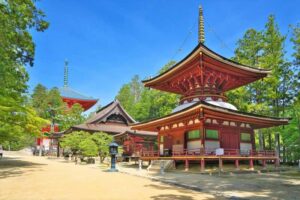
Mount Koya, also known as Kōyasan, is one of Japan’s most important and sacred religious destinations, located in Wakayama Prefecture on the Kii Peninsula. Rather than a single mountain peak, Mount Koya is a high-altitude basin at approximately 800 meters above sea level, surrounded by forested ridges and filled with temples, monasteries, and religious facilities.
It is the spiritual center of Shingon Buddhism, a major school of Japanese Buddhism, and has been a place of worship, training, and pilgrimage for over 1,200 years. The entire area forms part of the Sacred Sites and Pilgrimage Routes in the Kii Mountain Range, recognizing its outstanding cultural and spiritual value.
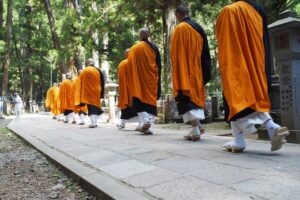
Unlike many historic sites that function primarily as tourist attractions, Mount Koya remains a living religious town. Monks reside here year-round, conduct daily rituals, and welcome visitors into a space where faith and daily life are deeply intertwined.
History and Religious Significance
Foundation by Kūkai
Mount Koya was founded in 816 by the monk Kūkai, who is also known by his posthumous title Kōbō Daishi. After studying advanced Buddhist teachings in Tang-dynasty China, Kūkai returned to Japan and introduced Shingon Buddhism, emphasizing esoteric rituals, mantra chanting, and symbolic practices.
He selected Mount Koya as the ideal site for spiritual training due to its secluded geography, natural harmony, and symbolic resemblance to a lotus flower, an important Buddhist motif.
Eternal Meditation Belief
According to Shingon belief, Kōbō Daishi did not pass away but entered a state of eternal meditation at Mount Koya. This belief remains central to worship today and gives the area a uniquely spiritual atmosphere. Followers consider Mount Koya not merely a memorial site, but a place of active spiritual presence.
A Living Center of Buddhism
For centuries, Mount Koya has functioned as:
-
A monastic training center
-
A destination for pilgrims
-
A repository of sacred texts, rituals, and architecture
Many temples continue to hold ceremonies that have changed little since the Heian period, making Mount Koya a rare example of uninterrupted religious continuity.
Major Sites and Cultural Experiences
Okunoin Cemetery
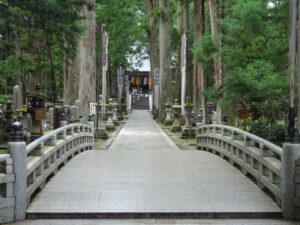
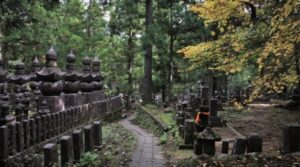
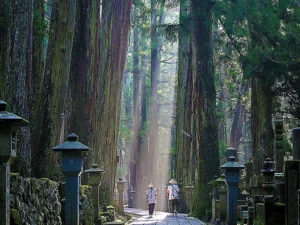
Okunoin is the most sacred site on Mount Koya and one of Japan’s most atmospheric places. The cemetery stretches over two kilometers through a forest of ancient cedar trees and contains more than 200,000 gravestones, memorials, and stone lanterns.
At its deepest point lies the mausoleum of Kōbō Daishi. The approach to the mausoleum is considered a pilgrimage in itself, encouraging quiet reflection and respect.
Danjo Garan Temple Complex
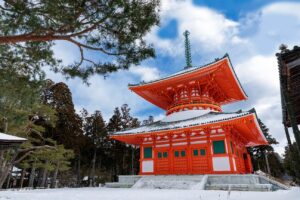
Danjo Garan forms the ceremonial heart of Mount Koya. This area contains pagodas and halls used for Shingon rituals and symbolizes the core teachings of esoteric Buddhism. The architecture and layout reflect Buddhist cosmology rather than decorative design.
Temple Lodging (Shukubō)
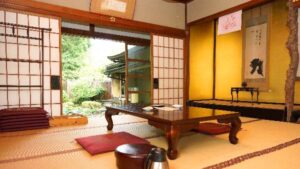
One of Mount Koya’s most distinctive experiences is staying in a shukubō, or temple lodging. Many temples offer overnight accommodation to visitors. Guests stay in traditional tatami rooms, dine on Shōjin Ryōri, and may attend early-morning prayer ceremonies.
This experience allows travelers to observe monastic life firsthand and gain insight into Buddhist values such as discipline, simplicity, and mindfulness.
Seasonal Atmosphere
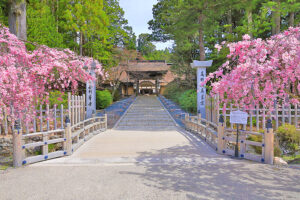
Mount Koya’s appearance changes dramatically with the seasons:
-
Spring brings fresh greenery and blossoms
-
Summer offers cooler temperatures than nearby cities
-
Autumn features vivid red and gold foliage
-
Winter transforms the area into a quiet, snow-covered spiritual landscape
Each season offers a different perspective on the mountain’s spiritual character.
Access, Etiquette, and Travel Tips
How to Get There
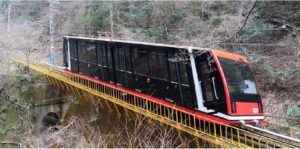
Mount Koya is most commonly accessed from Osaka. Travelers take the Nankai Railway to Gokurakubashi Station, then transfer to a cable car that ascends the steep mountainside. Once on the mountaintop, local buses connect the major temple areas and accommodations.
Visitor Etiquette
As Mount Koya is an active religious community, respectful behavior is essential:
-
Speak quietly, especially near prayer areas
-
Follow photography rules, particularly indoors
-
Dress modestly when entering temples
-
Be mindful of monks and worshippers
Facilities and Services
The area includes visitor information centers, small cafés, souvenir shops, and restaurants. English guidance is available at major sites, though the overall environment remains intentionally calm and understated.
Recommended Length of Stay
While Mount Koya can be visited as a day trip, an overnight stay is highly recommended. Evenings and early mornings offer a profound sense of stillness once day visitors leave, allowing travelers to experience the mountain’s spiritual atmosphere at its deepest.
Mount Koya offers foreign visitors a rare opportunity to encounter Japan’s spiritual heritage in a setting where history, religion, and daily life continue side by side. Through its temples, forests, rituals, and silence, it reveals a side of Japan that is contemplative, timeless, and deeply meaningful.
Related articles

Official Website
I also share travel information and Japan travel updates on X.
X (formerly Twitter)
Recommended Travel Services
