Overview
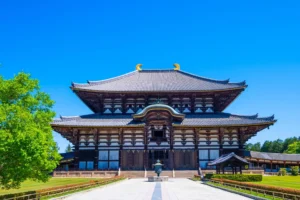
Tōdai-ji is one of Japan’s most historically important and architecturally impressive Buddhist temples. Located in Nara, the ancient capital of Japan from 710 to 794, Tōdai-ji was established in the 8th century and remains a powerful symbol of early Japanese state Buddhism.
The temple complex is part of the “Historic Monuments of Ancient Nara,” a UNESCO World Heritage Site. It is most famous for housing one of the largest bronze Buddha statues in the world, known as the Great Buddha (Daibutsu), inside the monumental Great Buddha Hall (Daibutsuden).
For international visitors, Tōdai-ji offers a unique opportunity to experience monumental Buddhist architecture, deep spiritual heritage, and the atmosphere of Japan’s earliest centralized capital.
Historical Background and Religious Significance
Foundation in the Nara Period
Tōdai-ji was founded in 752 during the Nara period under Emperor Shōmu. At that time, Japan was heavily influenced by Chinese political systems and Buddhist philosophy. The emperor promoted Buddhism as a means of protecting and unifying the country.
The temple was established as the head of a nationwide network of provincial temples. Its construction required enormous resources, drawing materials and labor from across Japan. The Great Buddha statue symbolized both religious devotion and political authority.
The Great Buddha (Daibutsu)
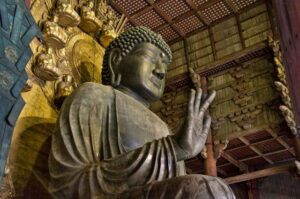
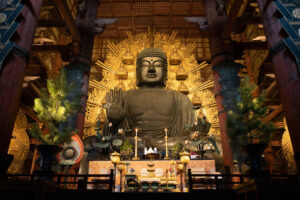 The central icon of Tōdai-ji is the Vairocana Buddha (Birushana Butsu), commonly called the Great Buddha of Nara. Key facts include:
-
Height of approximately 15 meters
-
Cast in bronze
-
Originally gilded with gold
The statue represents cosmic Buddha wisdom and universal enlightenment. Although it has undergone repairs over the centuries due to fires and earthquakes, much of its core structure dates back to the 8th century.
Standing before the Great Buddha inside the vast wooden hall is one of the most awe-inspiring experiences in Japan.
Fires and Reconstructions
Throughout its long history, Tōdai-ji suffered multiple fires, especially during civil conflicts in the 12th and 16th centuries. The current Great Buddha Hall, rebuilt in 1709, is smaller than the original structure but still ranks among the largest wooden buildings in the world.
The repeated reconstructions demonstrate the temple’s enduring cultural and religious importance.
Main Structures and Architectural Highlights
Great Buddha Hall (Daibutsuden)
 The Daibutsuden is the architectural centerpiece of Tōdai-ji. Its massive wooden beams, high ceilings, and symmetrical design reflect advanced engineering of the Edo period reconstruction.
Inside the hall, visitors can see:
-
The Great Buddha statue
-
Two large guardian Bodhisattva statues
-
A wooden pillar with a hole at its base
The hole in the pillar is said to be the same size as the Great Buddha’s nostril. According to tradition, passing through it brings good luck and enlightenment. This activity is popular with children and adventurous adults.
Nandaimon Gate
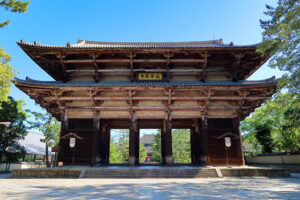 The Nandaimon (Great South Gate) serves as the grand entrance to the temple complex. It houses two imposing wooden guardian statues (Niō), carved in the 13th century. These dynamic figures are masterpieces of Kamakura-period sculpture and convey powerful movement and realism.
Nigatsu-dō Hall
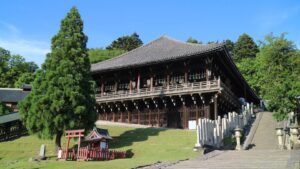 Located on a hillside within the Tōdai-ji complex, Nigatsu-dō offers panoramic views of Nara city. It is especially known for the Omizutori ceremony held annually in March, one of Japan’s oldest Buddhist rituals.
The wooden balcony overlooking the city provides a peaceful and scenic atmosphere, particularly at sunset.
The Temple Grounds and Nara Park
Integration with Nara Park
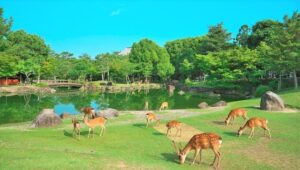 Tōdai-ji is located within Nara Park, a large public park famous for its freely roaming deer. These deer are considered sacred messengers of the gods in local Shinto belief.
Visitors can purchase special deer crackers (shika senbei) to feed them. While generally gentle, the deer can be assertive when they see food, so caution is advised.
Seasonal Beauty
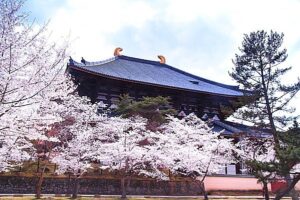 The temple grounds change dramatically with the seasons:
-
Spring: Cherry blossoms frame the temple structures.
-
Summer: Lush greenery enhances the wooden architecture.
-
Autumn: Brilliant red and orange foliage surrounds the halls.
-
Winter: Occasional snow creates a serene and photogenic scene.
Each season offers a distinct atmosphere for photography and contemplation.
Visitor Information and Travel Tips

Access
Tōdai-ji is accessible from JR Nara Station or Kintetsu Nara Station. From Kyoto or Osaka, Nara can be reached in approximately 45–60 minutes by train.
From central Nara, the temple is about a 20–30 minute walk through Nara Park.
Admission and Hours
There is an admission fee to enter the Great Buddha Hall. Hours vary slightly depending on the season, typically opening in the morning and closing in the late afternoon.
It is advisable to check official information before visiting, especially during holidays or special events.
Recommended Visiting Time
Allow at least:
-
1.5 to 2 hours for the Great Buddha Hall and surrounding structures
-
Additional time if exploring Nigatsu-dō and walking through Nara Park
Visitors interested in history or photography may wish to spend half a day in the area.
Cultural Etiquette
-
Speak quietly inside temple halls.
-
Photography may be restricted in certain areas.
-
Dress modestly as a sign of respect for the religious setting.
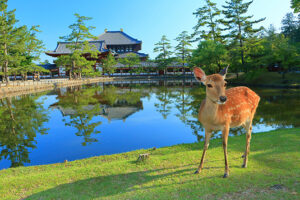
Tōdai-ji is not merely a tourist attraction; it is a monumental expression of Japan’s early political ambition, religious devotion, and architectural mastery. The scale of the Great Buddha, the craftsmanship of the wooden structures, and the peaceful environment of Nara Park combine to create one of the most profound cultural experiences in Japan.
For international travelers seeking to understand Japan’s spiritual and historical foundations, Tōdai-ji stands as an essential and unforgettable destination.
Related articles

Official Website
I also share travel information and Japan travel updates on X.
X (formerly Twitter)
