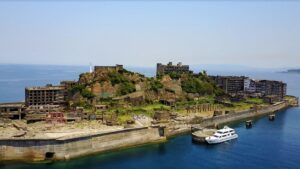
Gunkanjima, officially known as Hashima Island, is one of Japan’s most dramatic and historically significant abandoned sites. Located about 20 kilometers off the coast of Nagasaki, the island rose to global fame for its fortress-like appearance, resembling a battleship from afar—hence the nickname “Battleship Island.”
Once one of the most densely populated places on Earth and a symbol of Japan’s industrialization during the 20th century, Gunkanjima is today an evocative ruin. Its towering concrete apartment blocks, crumbling mine structures, and wave-battered seawalls offer a rare glimpse into the life and hardship of a coal-mining community that once thrived in extreme isolation.
Overview
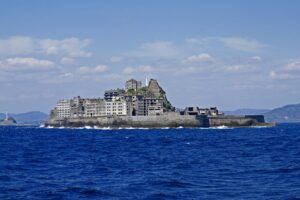
Hashima Island was a major undersea coal mining center operated primarily by the Mitsubishi Corporation. Between 1890 and 1974, massive amounts of coal were extracted from beneath the seafloor, powering Japan’s rapid industrial growth during the Meiji, Taishō, and Showa eras.
At its peak in the 1950s, Hashima had:
-
Over 5,000 residents on an island only 480 meters long and 160 meters wide
-
One of the highest population densities in world history
-
Housing complexes, a school, shops, restaurants, a hospital, a shrine, and entertainment venues—effectively a compact floating city
After the shift from coal to petroleum, the mines closed in 1974, and the island was abandoned almost overnight. For 35 years, Hashima stood untouched, slowly eroding from wind, salt, and waves.
In 2015, Gunkanjima was included as part of the UNESCO World Heritage Site “Sites of Japan’s Meiji Industrial Revolution.”
What Makes Gunkanjima Unique
1. A Real-Life Post-Apocalyptic Landscape
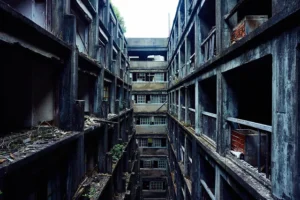
Visitors often describe Gunkanjima as:
-
A concrete “ghost city”
-
A real-life setting for dystopian films
-
A powerful visual representation of rapid urbanization followed by sudden abandonment
The empty apartment blocks, collapsed roofs, shattered windows, and rusted machinery paint a dramatic picture of life frozen in time.
2. Engineering on an Extreme Scale
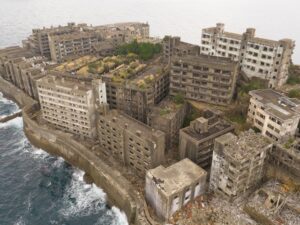
Due to limited space, the island underwent extensive land reclamation and was reinforced with:
-
Massive seawalls to withstand typhoons
-
Japan’s earliest large-scale reinforced concrete buildings
-
Vertical urban planning, with multi-story high-rises built in the 1910s
Hashima became a testing ground for architectural innovation in high-density living.
3. Harsh Mining Conditions and Social History
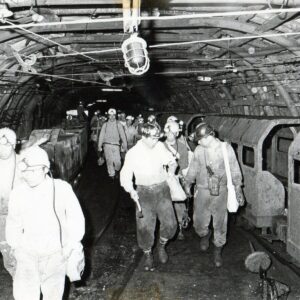
Life on Gunkanjima was tough:
-
Miners descended through long, dark shafts deep under the sea
-
Work was dangerous, noisy, and physically exhausting
-
Typhoons frequently isolated the island
-
Space was extremely limited, creating dense living conditions
The island also has a complex history involving laborers from mainland Japan, Okinawa, and Koreans during the wartime period, which remains an important part of its story.
Visitor Experience on Gunkanjima Today
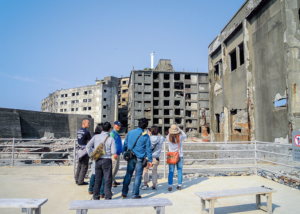
Since 2009, tourists have been allowed to visit through licensed tour operators. While much of the island is too dangerous for walking, designated viewing platforms allow visitors to safely observe the ruins.
Typical Tour Highlights
-
Boat ride from Nagasaki Port (35–50 minutes)
-
Approaching the island’s iconic battleship silhouette
-
Landing at the southern pier
-
Guided walking tour along designated paths
-
Detailed explanations of mining life, architecture, and island history
Only certain areas are open due to structural instability, but the views of Block 30 (Japan’s oldest concrete apartment building), the mine shaft towers, and the surrounding seawalls are especially memorable.
Important Structures You Will See
1. Block 30 (Building No. 30)
Completed in 1916, it is one of Japan’s oldest reinforced concrete apartment buildings.
This structure is a key model in early disaster-resistant urban design.
2. The Primary School Building
Once filled with children, classrooms, and rooftop playgrounds, it now stands as a haunting reminder of a once-vibrant community.
3. Mining Facilities
You can view the massive concrete frames that supported the mine shafts and conveyor systems used for coal transport.
4. The Seawalls
Built to withstand violent storms, these walls show the scale of engineering required to protect such a small, exposed island.
Access and Transportation
Departure Point
Most tours leave from:
-
Nagasaki Port Terminal
-
Ohato Terminal
Travel Time
-
35–50 minutes by boat, depending on sea conditions.
Tour Requirements
-
Visiting the island is allowed only through licensed tour companies.
-
Tours may be canceled on the day due to rough seas, which is common.
Recommended Tour Operators
(Names only; you can search locally)
-
Gunkanjima Concierge
-
Gunkanjima Cruise
-
Yamasa Kaiun
Reservations are strongly recommended, especially during weekends and holidays.
Best Time to Visit
-
Spring and autumn: Most stable weather, comfortable temperatures
-
Winter: Clear views but more frequent tour cancellations
-
Summer: Dramatic scenery but hot and humid
Morning tours often offer calmer seas.
Tips for Visitors
-
Tours may be canceled even after departure due to strong waves; safety takes priority.
-
Wear comfortable shoes; walkways are uneven.
-
Bring a jacket or windbreaker—sea breezes can be strong.
-
Follow all safety instructions; entering restricted areas is strictly prohibited.
-
Photography is allowed but drones are banned.
Why You Should Visit Gunkanjima
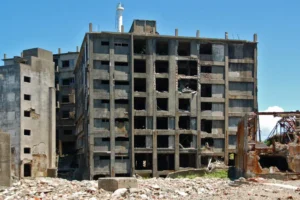
Gunkanjima is not just an abandoned place—it is a living monument to Japan’s industrial revolution, the resilience of mining communities, and the complexities of modern history. Its towering ruins and dramatic landscape offer an unforgettable experience unlike anywhere else in the world.
For travelers interested in:
-
Industrial heritage
-
Urban exploration
-
Architecture
-
History and culture
-
Photography
Gunkanjima is an essential destination.
Related articles
Official Website
https://www.gunkanjima-concierge.com/
Great Accommodation Site
